
PRIK (Python Runtime Interop Kit) generates native Python bindings for Fortran and C code.
Project status: Alpha. Core Fortran workflows and the currently supported
C wrapper features are implemented and tested across supported compilers, but
public APIs may still change before 1.0.
PRIK supports both languages. Fortran currently has the broader, more mature
wrapper surface. C currently supports a focused wrapper subset: primitive
values, one-level pointers, NumPy arrays, and strings. In both languages,
editable .pyi contracts let you shape the Python API. See C
User Guide for C workflows and C
Support for current coverage.
From Fortran to Python in one command
Install the package in a virtual environment:
python3 -m pip install prik
Create scale.f90:
real(8) function scale(value, factor) result(output)
  real(8), intent(in) :: value
  real(8), intent(in) :: factor
  output = value * factor
end function scale
Build an importable extension:
python3 -m prik scale.f90
Call the generated Python API:
import numpy as np

import scale

result = scale.scale(np.float64(3.0), np.float64(2.5))
print(result)  # 7.5
No manual binding code is required. PRIK derives the native wrapper and a readable Python signature from the Fortran source.
From C to Python in one command
Create native_math.c:
double add(double left, double right) {
    return left + right;
}
Build an importable extension:
python3 -m prik --language c native_math.c \
  --compiler cc \
  --out native_math \
  --out-dir build
Call the generated Python API:
import sys

import numpy as np

sys.path.insert(0, "build")
import native_math

print(native_math.add(np.float64(3.0), np.float64(2.5)))  # 5.5
This source build also writes an editable contract. For C pointers, arrays, and authored contracts, see the C User Guide.
Shape the Python API
For a richer API, PRIK lets you reshape the generated Python surface without changing the native implementation. Switch tabs to compare the default and edited versions.
The .pyi Format defines the contract language;
Editing .pyi Contracts shows the
supported transformations.
Fortran source
Create points.f90:
module points
  implicit none

  type :: point
    real(8) :: x = 0.0d0
    real(8) :: y = 0.0d0
  end type point

contains

  subroutine move(item, dx, dy)
    type(point), intent(inout) :: item
    real(8), intent(in) :: dx, dy
    item%x = item%x + dx
    item%y = item%y + dy
  end subroutine move

  real(8) function norm_squared(item) result(value)
    type(point), intent(in) :: item
    value = item%x * item%x + item%y * item%y
  end function norm_squared

end module points
Build:
python3 -m prik points.f90 --out geometry
Default API
import numpy as np
import geometry.points as points

item = points.point(x=np.float64(3.0), y=np.float64(4.0))
points.move(item, np.float64(1.0), np.float64(-2.0))

print(item.x, item.y)             # 4.0 2.0
print(points.norm_squared(item))  # 20.0
Generated contract
The generated points.pyi is:
from prik.contracts import Addr, Arg, Float64, native_call

class point:
    x: Float64 = 0.0
    y: Float64 = 0.0

    def __init__(self, *, x: Float64 = 0.0, y: Float64 = 0.0) -> None: ...

@native_call([Arg(0), Addr(Arg(1)), Addr(Arg(2))])
def move(item: point, dx: Float64, dy: Float64) -> None: ...

def norm_squared(item: point) -> Float64: ...
Generate it:
python3 -m prik generate --pyi points.f90 --out contracts
Edited .pyi
The edited points.pyi is:
from prik.contracts import Addr, Arg, Float64, Pass, bind, native_call

class point:
    x: Float64 = 0.0
    y: Float64 = 0.0

    def __init__(self, *, x: Float64 = 0.0, y: Float64 = 0.0) -> None: ...

    @bind("move")
    @native_call([Pass(), Addr(Arg(0)), Addr(Arg(1))])
    def translate(self, dx: Float64, dy: Float64) -> None: ...

    @native_call([Pass()])
    def norm_squared(self) -> Float64: ...
@bind("move") maps the Python-facing translate method to the native
move procedure. norm_squared needs no @bind because its Python and
native names already match. Pass() supplies the receiver (self) to the
native call; Addr(Arg(...)) passes the remaining arguments by address as
required by the native calling convention.
Build from the contract:
python3 -m prik contracts/__init__.pyi \
  --native-fortran-sources points.f90 \
  --out geometry
Edited Python API
The native Fortran is unchanged, but the Python surface is now:
import numpy as np
import geometry.points as points

item = points.point(x=np.float64(3.0), y=np.float64(4.0))
item.translate(np.float64(1.0), np.float64(-2.0))

print(item.x, item.y)       # 4.0 2.0
print(item.norm_squared())  # 20.0
Same Fortran source, but a more natural Python API: module procedures become methods.
Want to run that loop yourself? The quickstart notebook does exactly this —
compiles a Fortran cell and a C cell, then reshapes the generated API by editing
its .pyi contract. It needs no installation.
▶ Run it in Colab ⬇ Download the notebook
Why PRIK
- Natural Python APIs: Fortran modules become namespaces and derived types become classes.
- Editable contracts: generated
.pyifiles let you rename, hide, flatten, or reorganize the public API. - Explicit native behavior: NumPy dtypes, array layouts, ownership, and lifetimes are checked at the boundary.
- Clear limits: unsupported contracts fail before wrapper generation with actionable diagnostics.
Proven on real libraries
The maintained example suite covers five Fortran libraries— BLAS, LAPACK, FFTPACK, MINPACK, and BSPLINE-FORTRAN—and two C libraries: libm and TA-Lib. Each project has a complete build and numerical validation workflow, including its tested platforms and toolchains, in the Examples Gallery.
Measured against NumPy's f2py
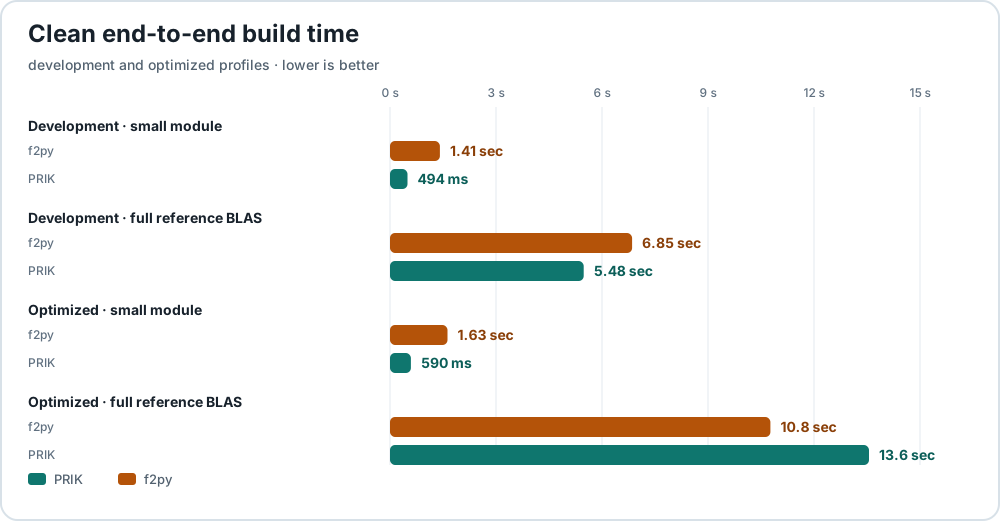
The reproducible performance comparison measures PRIK and NumPy's f2py against the same Fortran kernels on the same machine. The charts show the current published snapshot. Results are specific to its machine and toolchain, which are documented with the full results.
Runtime-call performance — values above 1.0× favor PRIK.
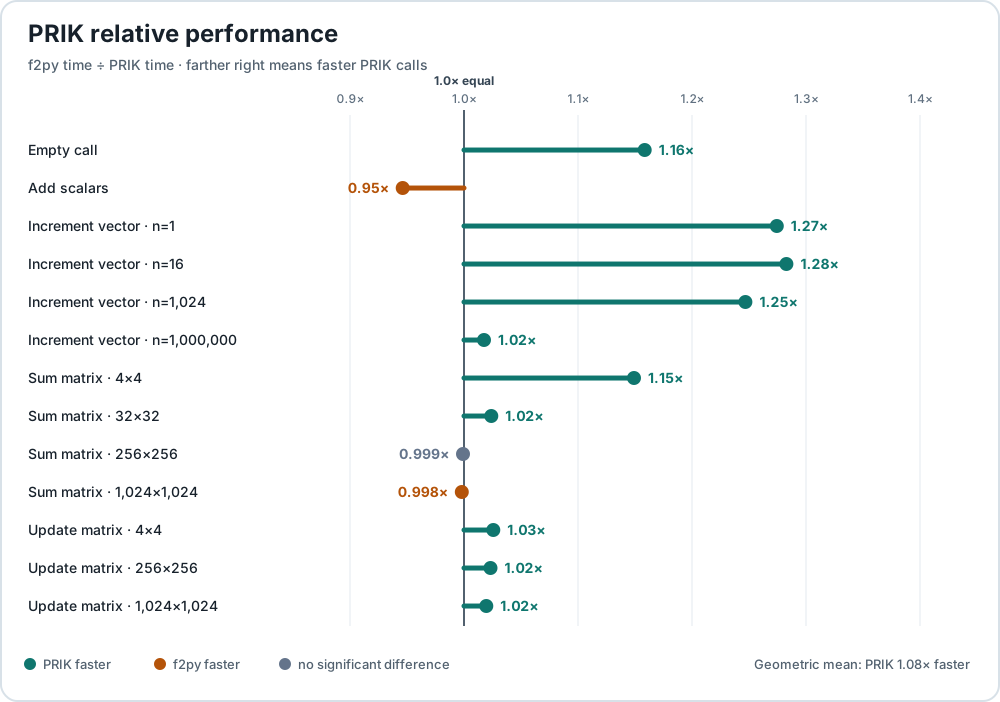
The chart shows f2py time ÷ PRIK time: values above 1.0× favor PRIK and
values below 1.0× favor f2py.
Clean end-to-end build time — lower times are better.
See the benchmark machine, full results, and methodology →
Ready to wrap your Fortran project?
Install PRIK → Read Getting Started →
Wrapping a supported C API?
Working on PRIK itself?